Tuesday, April 3, 2018

My New Ecuador Home

After 11 weeks of training, interviews, and a big flowery ta-doo, the Peace Corps staff finally announced our new assigned sites.  I was hoping for the green hillsides of the Sierra highlands and I got my wish.  I am moving to the city of Ibarra in the northern Ecuadorian province of Imbabura. 


Alex (Texas), Elias (Seattle), Kendall (Texas), Rachel (California) and I are all going to be neighbors and English teachers for various communities of the Imbabura Province. I'm lucky to share this site with some of my favorite fellow volunteers!

Ibarra is a colonial city (population 140,000) with a lot of spanish influence.  I'm going to enjoy the relaxed feel of its tree lined plazas, Colonial architecture and European style cafes.  It's only about two hours north of Quito, but because its elevation is only at 7,300 feet high, it will be a little
warmer throughout the year.  Bonus:  It's latitude is still considered 0 degrees, so I'll officially be living at the Equator during my two years of Peace Corps service. 

This is Lucy!  A single mom and my Cooperating English Teacher at the high school where I'll be working.  She has agreed to host me in her home for at least my first six months.  Lucy is from a big family here in Ibarra, loves to be active and is patient with my Spanish.  I think we're going to get along fabulously!


This is Lucy's home, high up on the hills on the outskirts of Ibarra. 
This will be my view of the city of Ibarra, the valley and Lucy's neighborhood.

Volcan Imbabura looms in the distance out my bedroom window.
I'm going to climb this mountain before my service is complete! 


Stay tuned for more pictures of Ibarra. 
I am permanently moving there after our graduation and Swear-In to Peace Corps service tomorrow!


Monday, April 2, 2018

Host Family Appreciation Day

     As our time is Peace Corps training comes to an end, the Ecuadorian Peace Corps staff have come up with so many creative ways to help us integrate into their culture. To say thank you to our families who have hosted us these 11 weeks, we created an Appreciation Day.  Many of my fellow trainees are very talented and they sang, played guitar, and acted in cultural plays.  I participated in a traditional dance with Hannah (from New Hampshire), Kendall and Alex (from Texas), and Melissa (from Florida). It took us many hours to practice for the day, but our families seemed to enjoy the nod to their traditions.


This week, I'm moving from my host family's home.  
Thank you to Amparo and Camilita for taking care of me. 


And thank you to Jenny and Donna for helping me to laugh through it all. 
You've been great host cousins. 


Finally, thanks to Horacio and Lily for greeting me at the door every day, and helping me to feel welcome, too!

Sunday, April 1, 2018

La Samana Santa- Ecuadorian Style!

Since Ecuador is primarily a country of Catholics, La Semana Santa (Easter), and the 40 days of Lent leading up to it, are a big deal. In the United States, Easter Sunday is the important holiday.  Here, Good Friday is the day of remembrance, memorialized with long church services, re-enactments of Jesus' walk to the cross, the crucifixion, and the laying of Jesus to rest. 

Quito, is known for its Easter reverence, and I joined my friends and family to experience this cultural tradition in the streets. 


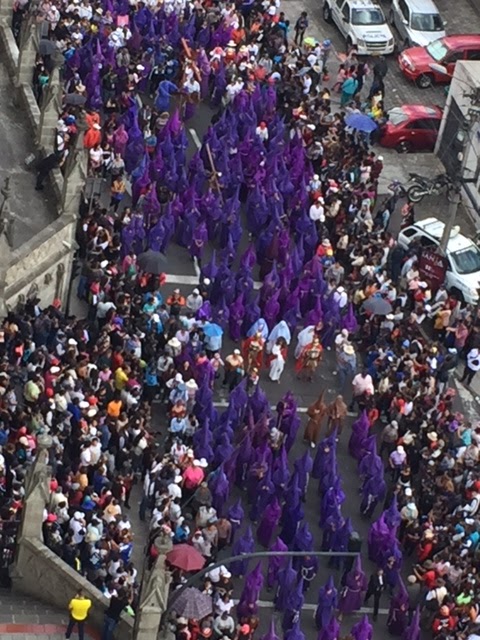
The most famous of all traditions is the Procession for Jesus del Gran Poder.  Men and women chosen by the church take part in a Good Friday procession to commemorate his walk to the cross, and the his suffering for our sins. 


Thousands of men and women chosen by their church join the procession as Cucuruchos. They wear their veil of penence and many walked barefoot, dragging chains, in order to gain redemption.  

Some were burdened with heavy wooden crosses, others had whips or nettles to self-flagellate, while others carried instruments playing the same death march music over and over again.
Some floats of flowers, honoring the Virgin Mary, or Jesus himself, were carried as well. 

After awhile of standing in the crowds, we decided to climb the Basilica to view the procession from above. 


The sea of purple penitents along the parade route of Quito.
At the end of the parade, thousands more poured into the streets to walk the route of Jesus.  Rain began, umbrellas came up, and the sea of moving colors captivated me from above.

It took almost 6 hours for these thousands of people to walk almost 5 km under the weight of their burdens.  I almost felt guilty sipping tea from the cafe above. Almost.

Upon returning home from Quito that evening, I rounded the corner of the main square in my town of Tumbaco, only to find the packed church getting ready for their evening mass.  I wish I would have taken a photograph of the altar, it was completely enshrined in the most beautiful wall of greenery and palm fronds.  A wooden Jesus statue was tied to the cross among the fronds.  Curiosity got the best of me, and I found a family friend to sit with, who could interpret the service.  Before long, as the story of the crucifixion was being narrated, men dressed in robes climbed up the scaffolding and very methodically, and symbolically, removed the statue from the cross.  When it was lowered, they placed it into a lit casket and started a procession out into the streets.  A huge puppet-like statue of the Virgin Mary was carried into the procession, as well as other characters in the historical story. 

All of a sudden, I was apart of a beautiful candle-lit procession through the streets of Tumbaco. 


The body of Jesus being carried through the streets with another thousand people joining the procession through the night.
After winding through the streets for probably 45 minutes, we returned to the church to find ALL the greenery gone, and the stark whiteness of light in its place.  By Saturday, the altar had been altered again into a display of beautiful white roses, with more processions in the streets throughout the weekend.

I feel so lucky to have witnessed all the beauty surrounding this important religious holiday. 


Ecuadorian Schools

Schools in Ecuador come in all shapes and sizes.  Some schools are only elementary, middle and high, while others are K-12.  Here's a glimpse into two Ecuador schools.


An elementary school in Guayaquil.  Along the coast, schools are in session from May - February,
avoiding the hottest months of March and April.  When I visited, the students were already on their summer vacation.


A functioning computer lab with 5 computers


Centro Tecnico is a technical middle and high school in Quito, where students can focus on automotive, industrial arts, electrical science and other trade programs.  I worked in this school for a 4-week practicum experience.  Schools in the Sierra Mountain region are on a September- June schedule to avoid the hottest months of July and August.

This school in built entirely around a giant concrete courtyard and bandstand where PE classes occur, as well as all school assemblies. I got to see an all school assembly honoring the women of the school on International Women's Day.  A Mariachi Band played on the bandstand and the entire student body stood in their class lines for 1 hour. 

Here is a typical class of high school students hard at work in their textbook.  In Ecuador, students are assigned a classroom and they stay in that classroom all day while their teachers of math, science, language, English, etc. rotate through the classrooms.  In my observation, this creates a strong classroom community among the students, but it also makes the teacher seem like a guest in "their classroom".  Students tend to really "run" the class.  They decide if their classroom floor is neat or messy, the walls or desks are clean or graffitied, or if they should sit in their assigned seat. Because teachers share all the classrooms, they are not allowed to hang any papers on the walls or post any resources/ information for the students.  Therefore, classrooms are stark and all information is kept in student notebooks to memorize.  Because students don't need to leave the classroom between subjects, the school can eliminate passing time.  Teachers are expected to run to their next class. When they arrive, all students stand up and provide a formal greeting until they are told to sit down.  Since all students are tracked into the same classes every day, I have seen no evidence of modifications for student needs such as Special Education programs or advanced curriculums.  That said, many high schools offer an International Baccalaureate program. If students earn high marks and are accepted into this program, all of their classes are spent together with this higher academic focus.  These are the students expected to go on to specialty careers in the University. 


I shadowed "Teacher Gabby" through her English classes of Juniors and Seniors, and helped teach many of the lessons. This month, one class was learning vocabulary and grammatical structures of the active and passive voice around the theme of traditions. I taught a lesson about the US holiday of Thanksgiving.  Then, she asked the students to form groups to research, and present, different Ecuador traditions to "Teacher Becky". 

These high school students worked hard on their researched presentations and their English pronunciation, but in truth, I think Google Translator worked even harder.  
You will notice that these students are all wearing casual uniforms. This signifies that they are having PE that day.  On non-PE days, they wear their school's dress uniforms of dress sweaters, slacks or skirts.  All schools in Ecuador require uniforms in which the parents have to pay for.

One group taught me all about the New Year.  I found out that I'm supposed to wear yellow and red underwear at the New Year to invite wealth and love into my future. Another group taught me about the Ecuadorian traditions around El Dia de Los Muertos.
The best part of the presentations was that students asked if they could bring food to showcase the foods that are typical of each holiday.  For the New Year, they brought me 12 grapes for good luck.  For Dia de Los Muertos, they brought me Colada Morada, a sweet and warm strawberry/ mixed berry syrup soup.  Delicious!
This is traditional Fanesca, a thick soup made of 12 different grains and toppings representing each of the 12 apostles.  Ecuadorians eat this dish during Easter.  It tastes great, except for the salted cod included with it.  
They also brought some "espuma" (think shaving cream) to spray me with as part of a group's celebration of Carnaval!

Since Birthdays are a big celebration in Ecuador, the last group insisted that they teach me about what to expect on my birthday.  I knew what was coming, but I played along.  After singing the English and Spanish versions of Feliz Cumpleanos, I received the royal treatment!


I was so lucky to work with Teacher Gabby and her great students!


 The students were so sweet.  Since this was my last day, some of the groups wrote me a thank you card and made me a sign to take to my new site.  I'm not sure what the card is supposed to say - I could only help with so much English instruction in my 8 days there- but I loved the sentiment and their appreciation of my impact on their classes!

Thanks to the whole English Department of Centro Tecnico Colegio (High School) for making myself, and some other Peace Corps Volunteers, feel so welcomed and loved.  In addition to mentoring us, they made it a point to invite us to dinners and dancing!  They are such a fun group.  I hope to keep in touch and visit them again, soon!