Sunday, June 17, 2018

Intag Valley and the Ecuadorian Cloud Forest

Step. 
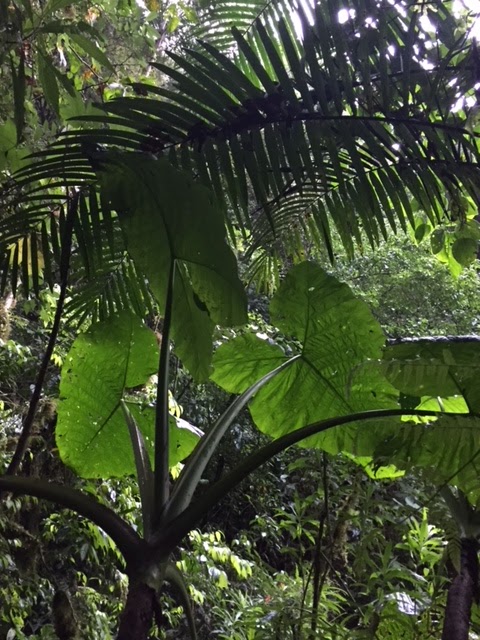
Peer through the layers of green.  So many textures.  So many species in the same square foot.  
Step.  
Pause.  So many sounds: the symphony of birds, the splashing of the water over rocks.  
Step.  
Breathe.  So many smells mingling together to form a rich, complex, earthy odor.  
Step.  
Water, water, everywhere.  
Sit silently aside the crystal clear stream, or among the forest layers, steadying your breath with the drip, drip, drip.  

This is the Cloud Forest of Ecuador.


+++++++++++++++++++++

Since I arrived in Ecuador, I've been hearing about the Intag Valley.  I've been reading about this valley, and asking others about its sights.  Finally, last weekend, my friend Ava and I grabbed three days to scratch the surface of this magical place.

Set in the high mountain Andes at about 6,000 feet in a Cloud Forest, the Intag Valley is home to about 17,000 people, mostly working as subsistence farmers, or promoting a little tourism to protect this special place.  After Googling about Cloud Forests, and the Intag Valley, I learned the following from a few different sources:

Cloud Forest: a wet tropical mountain forest at an altitude usually between 3000 and 8000 feet (1000 and 2500 meters) that is characterized by a profusion of epiphytes and the presence of clouds, even in the dry season.

According to the United Nation's World Conservation Center, cloud forests comprise of only 2.5% of the world's tropical forests, and approximately 25% of those are found in the Andean region (i.e. Ecuador, Peru and Bolivia).  The cloud forests of the Intag River Valley are at the confluence of two of the world's hottest of the biological hotspots.  One of these hotspots, the Tropical Andes Hotspot, is considered the single richest hotspot on the planet, and it contains approximately 15-17% of the world's plant species and nearly 20% of its bird diversity.  For these reasons, Ecuadorian cloud forests are considered to be on top of the list of threatened ecosystems.


And it's only a few hours from my house!

The first part of the adventure was braving the bus ride down, down, down into the valley.  The road was so steep and curvy that the driver had to pull over to let people off to puke.  Not me!  (Here's my promotional plug for my wonderful stomach-settling PSI Wrist Bands.  I wear them everywhere I travel, and I never get motion sick!)  

With little more than these directions: "get off the bus at the yellow church and walk up the dirt road for an hour," we ventured into the agricultural valley of Santa Rosa and into the cloud forest.
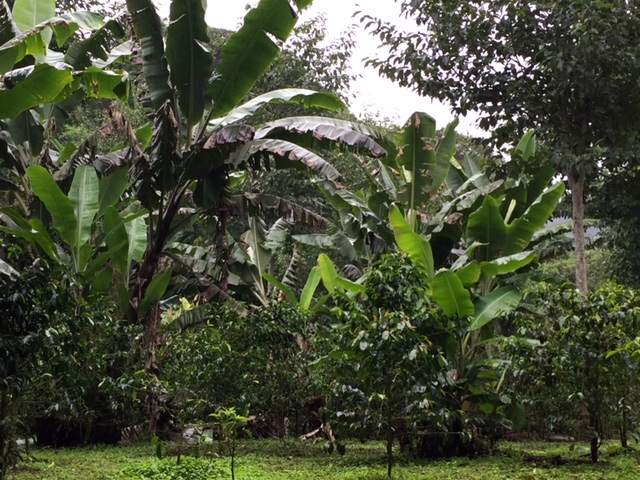
Along the road, we spotted banana and coffee plantations and a wide variety of other plants.  


Even though we were at a lower elevation, it was surprisingly cold in the forest.


At last, our cabin came into view, and our wonderful host welcomed us into this sweet little room in the treetops. 


The hammock overlooking the forest was the best of all.  Cuddled in a wool blanket, I relaxed out here much of the night listening to the nocturnal sounds of the forest.
In the morning, the cacophony was earsplitting.  Sleeping in this cabin was like being in a tree-house.  The windows are only screens and the sounds of the birds infiltrate the air. 
Time to hike!  It's was a beautiful day!


In the United States, we spend so much money on proper hiking boots.  Here, they just walk in their Wellies.  High rubber Wellington boots are the norm and are passed out to the tourists.  They are a must as you wade across the streams, navigate a trail of deep, soggy mud and step over logs well into their state of decomposition.  

We hired a guide, Roberto, to take us deep into a primary forest of old growth trees.  Without his machete, we never would have found the quickly overgrowing trail. 


With his guiding, Roberto helped us to understand and appreciate the cloud forest.  We learned a lot about the adaptation of plants and animals in this unique environment. 


           Centipedes, salamanders, butterflies, a toucan, a Cock-of-the-Rock bird and a really cool weasel-like mammal called Cabeza de la Mate were the highlights of the day. 


Epiphytes, Orchids and Bromelides.  
Moss, Lichen and Fungus.  
Strangulating vines, and the damp earthy smell 
of a deep, wet, forest. 


A native fig tree, at about 500 years old. 
We also learned about how this forest is under threat from international mining companies looking for gold and copper.  The local people have been fighting the destruction of their valley for years, but the Ecuadorian government is currently selling off the mining rights to reap the profits.
So, so, sad.


This tree is called a Blood, or Sangre Tree because when he cut into it with his machete, a red liquid seeped out.  This liquid is well known to heal cuts or wounds,
as well as work as a great sun block.


About 5 hours later, wet and muddy, we emerged into the clearing back at our cabin.  A shower, a glass of wine, a little scrabble game, and a wonderful fish dinner from a trout farm down the road rounded out this perfect day.


The next morning, as we turned down the path and headed for home, I looked back for a final glimpse at this reserve.  The forest seemed to swallow up the cabins and the view.  But I didn't mind.  I know I'll be back to enjoy the wonders of the Intag Valley again and again.


Sunday, June 10, 2018

Open House at Teodoro Gomez de La Torre School

"Becky, we need an idea for the Open House."

"What do we have to do for the Open House?"

"Every class in the whole school does something for the Open House!  The English Department is assigned specific classes to highlight their English abilities.  We need you to help us think of a presentation we can make in English!"

And so it began, about 3 frantic weeks of planning for the Open House.  I had no idea how big this was going to be.  Each year, schools invite dignitaries, parents and community members to participate in a grand showcase of all the students have learned, and all the school has to offer.  Since my school is Pre Kindergarten-12 with over 4,000 students, this was a HUGE showcase all around the school.  It seems that each grade level chose or were assigned a theme, and specific classes developed projects around that theme. There are at least 5-6 classes in each grade level, so it was extremely interesting to see all that the students, teachers and parents created. 

The youngest students were showing off their knowledge of traditional foods - note the roasted cuy!
This young class had stations demonstrating the five senses. 

These students were showing off their knitting skills.  Handicrafts such as these are important in the traditional and Indigenous cultures as beautiful shawls, hats, blouses, and skirts are often handmade or bordered with hand stitched decorations.  Since there are many jobs in this sector, honing these skills are important for job opportunities in the future as well.
Painting and art is also honored in many ways in this country.  Art is everywhere in churches, museums, street murals and graffitied (sometimes beautifully done) all over the sides of buildings.  I haven't seen a lot of specific art classes, but it is obvious that art, music, and using the right side of the brain, is an important part of Ecuadorian society.


This grade level studied plants in their science classes and were demonstrating the life cycle and importance of plants. They were also giving away some handmade felt flowers to participants of their game.


These students were demonstrating some principals communities and of physics with their cardboard cities. 


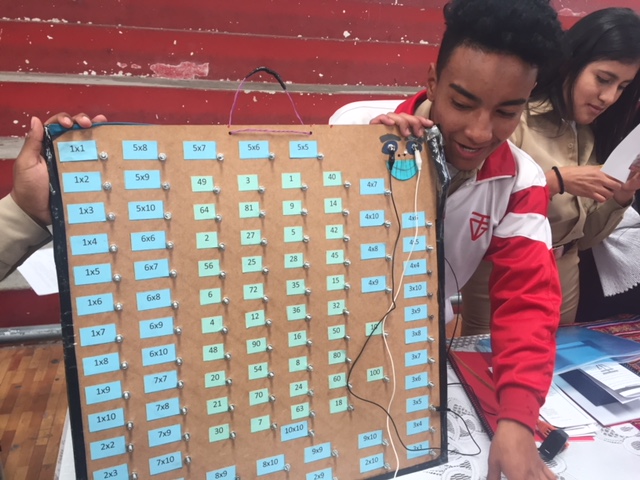
Many classes challenged younger students with math games.  This student used his knowledge of circuits to make a fun multiplication game. 
These students showed off their abilities in the Chemistry Lab


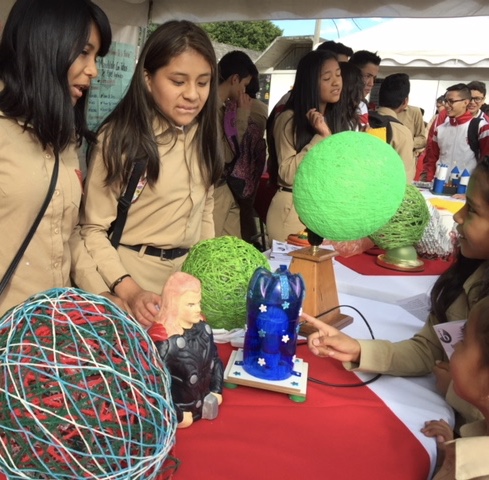
In a previous post, I have discussed the lack of teaching resources in this country.  However, as I am learning, that doesn't mean that Ecuador is completely without.  One just has to become very creative in reusing and repurposing the items they do have.  I really enjoyed watching these 5th grade and 9th grade students show off their ideas for products made from recycled objects.  I think we all could learn a lot from their creativity!
Lamps made from recycled or repurposed goods
Popsicle stick doll houses
Jewelry Boxes made from..... toilet paper rolls!
I see toilet paper rolls, egg cartons, plastic bottles, bottle caps....
The blue serving cups...entirely out of plastic bottle bottoms
Have a tire, and some foam?  You can make a chair!
How about we use all those plastic bottles in the world to make garbage cans for our cities!
Plastic bottles make great plant pots, too!
This student figured out how to repurpose newspaper!
Look closely.... these students repurposed metal oil drums into this stylish furniture.  

When I walked into the gymnasium, I was really surprised.  The older students were tasked with creating products and marketing material to promote their creations.  Here is a small sample of some of their products:

These students were so proud of their graphic novel which they had written, illustrated 
and published into a professional book.  
These girls created a line of perfumes.
These students created chocolate of various flavors.  I also saw many other
projects inventing cupcakes, marmalades, and fruity drinks. 

These boys were very proud of their line of shampoos, made entirely of natural products including aloe, grains, and tea. 

These students were showing off the traditional way to make ice cream in a paila,
adding their own unique flavors. 
And finally, something that you will NEVER see in US schools...
these students created a whole line of alcoholic fruit-flavored liqueurs.  They were giving out samples.  Quite strong, but delicious.  I gave them a thumbs-up!

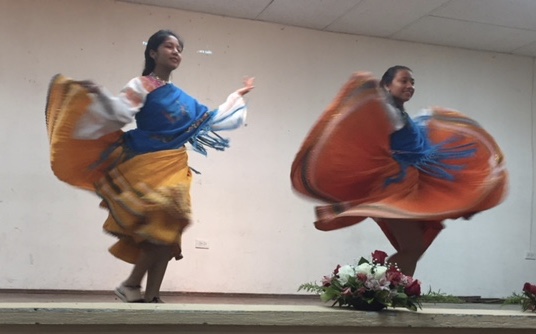
And the English Department?  Our teachers helped some 10th and 11th grade classes create cultural presentations about all the places to visit in the province of Imbabura.  Ofcourse, this was my idea because I wanted some tourist advice.  The groups did not disappoint.  They all created scripts (thanks to Wikipedia) to tell about the history, traditional culture, economy, climate, "gastronomy highlights" and tourist opportunities in each of regions of the province.  Then, they followed up these speeches with songs or dances in costume promoting the special heritage of each of these places.  I was impressed!  During our Peace Corps training, there was a lot of discussion about cultural appropriation and what was, and wasn't, appropriate when you showcase the characteristics of another culture that isn't your own.  These students aren't necessarily Indigenous, and they're certainly not all African Ecuadorian, but they all knew the songs and dances of other cultural groups around the province.  And they all own the authentic clothing to wear when they participate in these cultural  festivities.  In Ecuador, it seems that culture is everything that you are, and it is shared and celebrated by all in the community.


These students demonstrated a ceremonial dance and song at a traditional wedding 
of the Otavalo people.

These students performed a traditional dance of the people of Zuleta 

These students demonstrated a traditional dance called "San Juanito", of the people of Carabuela
These students performed a traditional dance called the "Bomba"

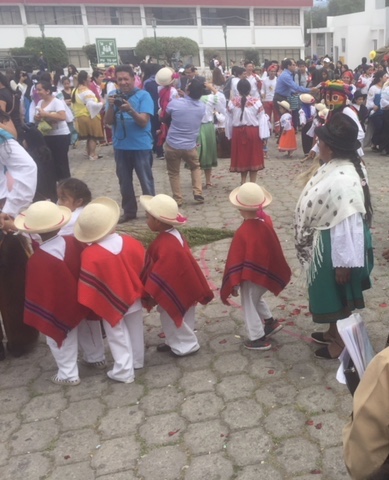
I asked one of the students how they knew all of these songs and dances from different cultures.  She told me that they have been learning them in school, and dancing them in the community, since they were very little.  Later that day, I witnessed the preschoolers showing off their first steps of these traditional dances.


This is the Director (the man holding the child) and Vice Director (the woman next to him) of our school dancing with the students.  The parents (some authentically Indigenous) were sharing 
their homemade Chicha, with the Directors.  
Chicha is a fermented alcoholic drink, shared by passing a gourd-bowl around the crowd.  Everyone took a long gulp.... something else you won't see in US schools.  


In the end, I was amazed.  First, there is so much more going on in this school than I had realized.  In a previous post, I discussed the (sometimes frustrating) realities of the Ecuadorian Educational System.  After witnessing this showcase of talents at this Open House, I'd like to end this post with a different take on those realities.  

Ecuadorians are raising "whole children".  It takes a village to raise a child, and as these children are growing up in the womb of so many cultures, languages and historical traditions, they are growing up loved, supported, well-balanced, and a part of something greater.  Because Ecuador is generally a kind and gentle nation, it's not made up of people who are fiercely independent, and competitive at the cost of others.  Perhaps because of this, they don't have the statistics of suicides, mental health issues, stress and diseases that more driven societies sometimes battle.  On the whole, I find Ecuadorians very strong, hard-working, intelligent and incredibly kind.  They are self-motivated, and creative as demonstrated by the number of small businesses, community initiatives, and the incredible things they accomplish with little resources.  These students, and everyone else in the community, are the product of the Ecuadorian school system.  With this lens, I have to admit, there's a lot of good going on.  Agreed, they're probably not winning all the academic prizes for science, math or medical advancements.  But in this society where the sum is greater than each of the parts, and they work to nurture and take care of each other, it seems like everyone is more happy in their everyday.  That's got to count for something. 


I'll leave you with a performance by a student, Chris Jami.  I have been told that he is well-known around the world for his Indigenous flute music.  He speaks English very well because he has travelled to the USA many times to perform.  Chris is an example of an exceptional Ecuadorian student using the strengths of his Ecuadorian heritage to make his own way in the world.  


Tuesday, June 5, 2018

Ecuadorian Bus Rides

Peace Corps Volunteers in Ecuador are not allowed to drive a car or a motorcycle.  So, I spend a lot of time walking or riding a bus.  In this post, I thought I'd share a little of that experience with you.


A bus is like a little moving community.  We all come aboard with the silent agreement, a trust in the driver to actually get us to our destination safely.  As we jiggle and cajole our way from the door to a hanging handle, a pole or railing –anything to grab- we come face to face with others, their armpits, and their oversized bags.  A quick contact of our eyes, a head nod, and often a sliver of a smile confirms that we’re in it together, and we’ll try to help each other stay upright, because, well, the alternative is a trampling.  With feet planted as if you’re on a boat, knees bent, and arms taught, we ride the curves and anticipate the acceleration and sudden stops along the journey.  If you’re lucky enough, the person you’re leaning over has to get off the bus before you, and you can steal a coveted moment in a seat, to stare out the steamed up windows and watch the street scenes fly by.  But don't be lulled into thinking that riding in a seat is much easier.  Some buses have plastic seats and you have to use your feet to brake for the sudden stops, or else you'll slide right out of your seat and flop onto the floor.  I know this from experience, again and again. 

You can buy ANYTHING on a bus…candy bars, chocolate balls, bags of peanuts, homemade pan de yucca that melts in your mouth, gum, mints, bags of oranges, cherries, CD’s, DVD’s, watches, jewelry, face lotion, cell phone cases.  Vendors get on at a stop, stand at the front and make a pitch about the benefits of their product or the poorness of their family, and then they walk from seat to seat trying to pass out their wares and hoping you’ll fork over the price.  Once, a woman came on the bus with an amplifier and she sang her heart out.  I donated to her cause.  During another bus ride, a man challenged the riders with quiz questions about Ecuador.  For every correct answer, you received a bead. At the end of the game, he passed out necklace rope to make your own necklace from the beads you had earned.  Of course, then you felt compelled to buy the necklace that you just made. Brilliant!  Bus rides are always entertaining!


Many farmers use the bus to carry large bags of produce to market.  That's normal to see.  This head had a price tag on it too.  It's definitely the most interesting thing I've seen on a bus so far! 

Every bus has a Bus Driver and an Assistant. The Assistant's job is very important.  At each stop, his job is to jump off, stand on the sidewalk and call out loudly the names of all the upcoming stops.  He strongly encourages you to board his bus by yelling "Sube! Sube! Sube!" or "Sigua! Sigua! Sigua!" which generally means "Get on the Bus!"  Then he squeezes between all the people to collect your 25 -30 cents, and somehow miraculously gets back to the door in time to jump off at the next stop and start screaming again.  Bus drivers and their assistants make a lot of money each day, and this job is primarily held by men.  I'm always pleased to see a husband and wife team working the stops and try to take their buses instead.

A bus driver is very talented.  He can maneuver between lanes, other cars, and around curves at top speed, all the while beeping his horn in rhythmic responses to the other cars sounding their horns as well.  A horn can mean any of the following:
--I’m coming into your lane
--Watch out, I’m coming through this intersection
--Get out of my way
A word of warning however, is that since bus drivers are always in a hurry to get to their next destination, they don't always feel obliged to come to a complete stop.  Learning how to get on or off of a moving bus is always a good skill to have!


In Ecuador, local bus stations are very efficient. You pay one price to enter the station and then you line up on the platform in a location that is designated for your destination. When the bus pulls up, the people who are disembarking get off the bus out the front door, while everyone entering the bus gets on through the back door at the same time.  Many people can board quickly and efficiently, because they’ve already paid for the ride.

A final note to round out your virtual bus riding experience.... the blaring Ecuadorian music! Sometimes that's how you know the bus is coming, you hear the music first.  Someday my Spanish will be good enough and I'll be able to sing along like so many of the other riders.  Like I said, bus rides are always entertaining!