This summer, Julie and I spent three weeks in the north-central part of Ecuador. Afterwards, Becky asked me to reflect on our travels and give some insight into how two people, with no prior knowledge of Ecuador, first perceived the country and the people she has come to know and love. So... here goes!
 |
| Julie and Becky enjoying the views of Quito
The first surprise for us was the weather. If you’re not already a world traveler, you probably think as we did: Ecuador, the Equator, developing country, hot and muggy, lots of jungle and mosquitoes. What a surprise to fly into Quito, and need a jacket! Yes, it’s on the Equator, but high elevations mean cool temperatures. Lower parts of the country can be hot and humid, but we spent most of our time at heights exceeding 9,000 feet above sea level.
|


 The bustling city of Quito is the Capital of Ecuador, and compares in size and energy to other world-class cities. Its people enjoy their city, its parks and playing fields – of which there are many – engaging in soccer and volleyball matches, shopping, dining or just enjoying the out-of-doors, at all hours. Quito’s historic district is the first World Heritage site so designated by the United Nations Educational, Scientific and Cultural Organization (UNESCO) and features many cathedrals, monasteries, plazas and buildings, dating back to the 16thcentury. Touring the historic district was a real treat.
Quito fills a valley for miles at the base of Pichincha Volcano, so the mountains are never far away. We explored them during two day-trips from the city. The Teleferico (think gondola) takes you up to 13,000 feet and is a great way to see the views and experience high altitude breathing, stiff winds and chilly temperatures. We noticed the altitude difference, but I think the flavored oxygen stand at the top is mostly for fun.
On another day, we looked for a similar stand when we were hiking on Volcano Cotopaxi. Julie and I were challenged to walk the winding, three-mile path to the hiker’s refuge at nearly 16,000 feet without passing out or retreating to the bus. Gasping like fish out of water, we plodded on, blasted by impressively high winds and pelted by frozen rain, before we were rewarded at the refuge with hot chocolate and chulpis (roasted corn “nuts”). No pics of the peak that day, unfortunately, but the experience was worth the effort.
 |
| Julie with the Cotopaxi Refuge in the background |
 As much as we enjoyed Quito, Julie and I were most taken by the visits with Becky to other parts of the country, starting with a trip to Mindo. This is a comfortable little town set in the cloud forest on the western flank of the Andes Mountains. It's a favorite of many tourists and ex-pats from all over the world. While there, we took a tarabita (cable car) across the river and hiked to several waterfalls, did the zip-line thing, toured a butterfly garden and had a coffee production tour. Great fun!


 While in Mindo, we got our first taste of Ecuadorian hostels. The rooms are generally simple and spare, often very small, but clean and quite reasonably priced. A bed in a small dormitory with shared bathing facilities is only a few dollars a night, or sometimes we splurged on a private room with a bath for a few dollars more. Our nights in our cloud forest hostel were spent in a treehouse-like room. The windows were wide open (no bugs or screens) to the cool mountain air and the sound of a rushing river below.
 |
| The Dawsons, Wandells and Angamarcas at Lake Cuicocha |
Next stop, Ibarra, where Becky lives with her host family, the Angamarcas. Julie and I stayed with them in their home for several days, and Jose and Margarita proved to be the most warm-hearted, welcoming, generous people one would ever hope to meet. Through them, their sons and other friends, we began to really understand why Becky is so enamored with the country and its people. We were instantly adopted as family, not just visitors, and the whole family bent over backward to make our visit comfortable and memorable. The Angamarcas seem to typify a general Ecuadorian attitude of industry, pride in their country and their people, and a willingness to share with others. These qualities were represented, too, by Anderson and Ernesto, two friends of Becky's who went out of their way to show us Ecuadorian hospitality.
Anderson is a chef, a musician, entertainer, and sometimes driver who befriended Becky out of a desire to practice his English with a bilingual, native English speaker. Anderson leapt at the chance to drive us cross-country and was an engaging tour guide and companion, stopping along the way to share with us a traditional breakfast of biscochos, (think biscotti), and to explore some beautiful waterfalls and local craft markets.
 |
| Anderson and Becky teaching us about Avocado Ice Cream |
 |
| Ernesto showing us an ancient agriculture calendar |
 |
| Lamb, mote (a variety of corn) with potatoes and salad for lunch |
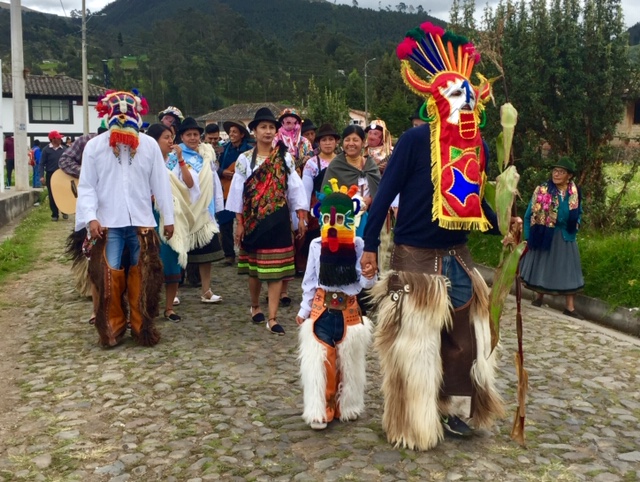
 The time we spent with Becky and the Angamarcas in Ibarra was a whirlwind of activity – never a dull moment. They welcomed us with a traditional dinner of tortillas baked over the fire in their outdoor kitchen, complete with toasts and endearing words. Then we were out early the next day to visit an Indigenous food market in search of unique Ecuadorian flavors, and to a live animal market to see chickens, ducks, guinea pigs, calves, cows, llamas, pigs and roosters change hands. Next, we headed off to the textile market in Otavalo where I bought an alpaca sweater and Julie found a lovely wool poncho and hand-embroidered table runner. Since Ecuador uses the US Dollar, prices for everything were well-below rates in the U.S. For lunch, we ate a typical Ecuadorian almuerzo of fried pork and a corn drink called Yamor. In the afternoon, we took a side trip to a nearby national park for a beautiful walk on the ridgeline above a large crater lake. On the way home, we visited another village market in the valley of Zuleta, attended Jose’s soccer game and finished the night at a local music festival in the Indigenous community of Esperanza. This community festival revealed still more clearly a general attitude of mutual respect and national pride in the many cultural influences that define Ecuador and its people. For example, we caught the award ceremony for the local pageant; two of the finalists wore modern evening gowns, while three others proudly wore the traditional dress that identifies and celebrates their Indigenous cultures. The crowd cheered for them all. The live bands at this festival also played traditional music, but were obviously influenced by rap and rock and roll. Ecuadorians of all ages seem to be equally comfortable with this mixture of old and new as the old traditions are honored, yet enhanced by modern influences from other countries and cultures near and far.
  |
| The local animal and textile markets |

 |
| Jose checking out a cuy at the animal market |
Among our novel experiences was our introduction to the Ecuadorian food, which is heavy – at least, in the areas we traveled – on meat and carbohydrates. We learned that there are 12 varieties of corn that are staples of the Ecuadorian diet, that potatoes, yucca and rice are often served together as side dishes – breakfasts included – and that guinea pig is as accepted as chicken, fish or beef for the main course. Guinea pig (roasted or fried) and farm-raised tilapia fish are generally served whole with the heads still attached. This was particularly “off-putting” for Julie, but she ate it as long as it wasn't looking back at her from her plate. From my point of view, the fried guinea pig was delicious!
 |
| Becky has obviously gotten used to eating her fish with the heads attached. |
 |
| A variety of foods we found at a market |
 |
| Becky demonstrating how to suck pulp out of the granadilla fruit. |
Fruits, many of which we had never seen before, were in abundance, too. We enjoyed sampling them at the markets, blended into locally produced smoothies or ice cream pops from a stand on the street, or cut up and sold in slices by vendors everywhere.
We followed Becky’s lead in using public transportation (and our feet) to see the country. Uber, taxis and buses were convenient in Quito. More comfortable travel buses connected us to towns across the country. Since few citizens outside the cities own cars, bus fares range from a quarter within the city, to about $5 for longer-distance travel. At each bus terminal, there is a “staffed” restroom. For a small fee you can use the facility, and get some toilet tissue, too. This model keeps the restrooms clean and tidy, but soap and a towel are less common.
Enterprising Ecuadorians have also addressed the fast food movement that we see here in the States. While there are no “drive through” eateries in Ecuador, the vendors bring their food and wares to you. On the streets, vendors sell from coolers, backpacks, push carts and bicycle-driven carts. They are young people in modern dress and older folks in traditional garb, deftly wending their way through typical urban crowds and traffic jams, selling food, dog beds, kitchen linens, underwear, washing machine covers or paintings. It’s routine for vendors to get on and off the buses with their fresh fruit, snacks, and simple meals of meat and fried potatoes – no worries about going hungry during your travels! Interestingly, vendors of non-food items jump on-and-off, too, and give their pitches from the front of the bus for the lotions, electronics, or candy they want you to buy. They first hand out their products for inspection, then take them back -or take your money- before getting off the bus to board another and pitch their wares again.

 Next on our itinerary was a visit to Tena and the Amazon Rain Forest. We splurged on a resort
on the banks of the Napo River, a large and fast-running tributary that feeds into the Amazon River. While most homes in the area no longer have thatched roofs, it sure set the scene for our visit to the jungle.

The capstone of this visit was a day trip by motorized canoe to a wildlife recovery center that rehabilitates and returns wild animals to the rain forest, often after their recovery from smugglers. Our host and captain was a member of one of the local Indigenous communities, and he led us on a vigorous hike, pointing out medicinal plants, wild monkeys and even a communication tree. When struck, the tree makes a sound. Hunters once used it as a sort of jungle telegraph. The number of times the tree was struck signaled their message: “I’m lost…I’m hurt…I need help carrying my kill back to the village.”


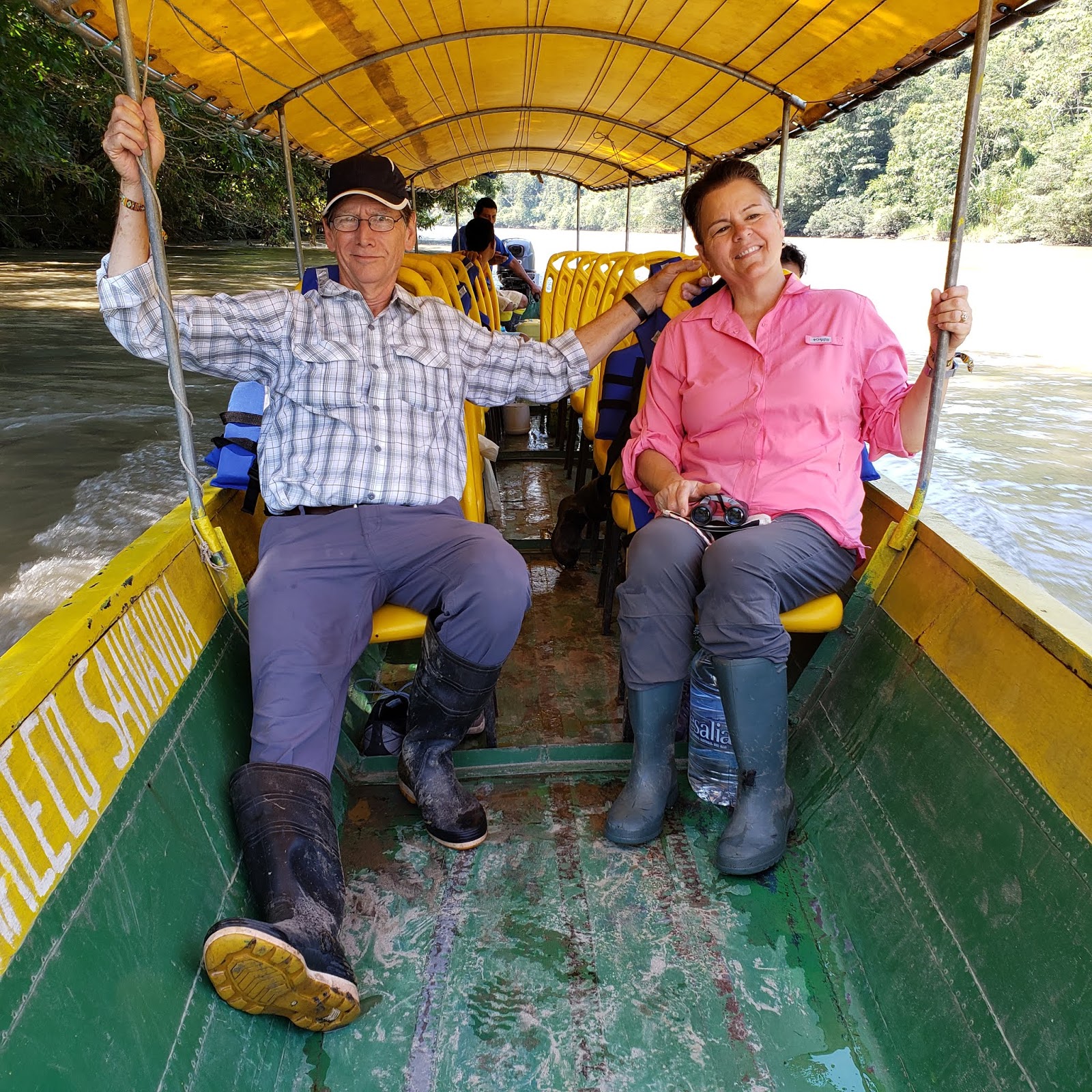


Julie and I could not have enjoyed our trip to Ecuador more. Everyone seemed eager and open for conversation, including the elderly man who stopped on a trail to shake our hands. We are impressed by the entrepreneurial and community-focused spirit of the people. I can’t help but wonder where their energy comes from; when do they rest? Many thanks to Becky for making herself so available, as our guide and our interpreter. And, thanks again to the Angamarca family and friends for welcoming us into their home and community to teach us, share with us, and entertain us during our time with them. We look forward to our next visit to this wonderful country.
-Doug Dawson