Thursday, February 6, 2020

Quick Trip to the Ecuadorian Oriente

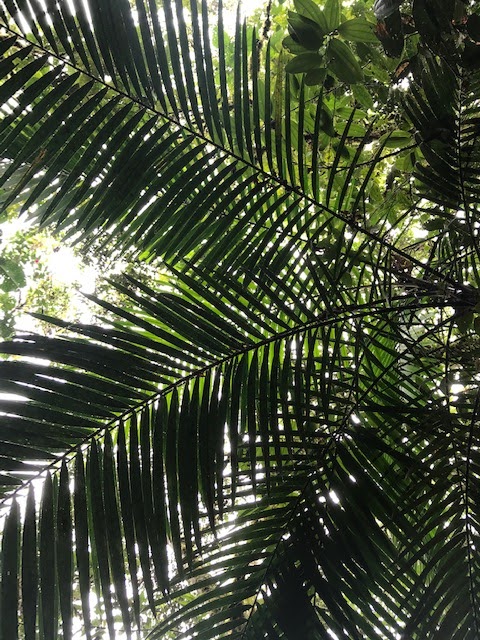
Over the holidays, I took advantage of the school vacation, and stole away for two days to explore a part of Ecuador I hadn't seen before.  It was my Christmas present to myself.  After a 2 1/2 hour bus ride east of Quito, I found myself dropping into the edge of the Oriente or Amazon Rainforest - a wonderland of unique plants, birds and a little adventure for me. 


I booked one night in Rio Quijos Eco Lodge in Baeza, Ecuador and a big surprise awaited me when I arrived.  A tour group of white-water rafters from the US were using this as a home base to raft several rivers over a week.  I had a great evening chatting with them and 
learning about this area as a world-class rafting destination.  
In the waning light of the first day, I relaxed along the Rio Quijos, which flows into the 
Rio Coca and the Rio Napo, before meeting up with the Amazon.


Butterflies and birds were everywhere.

The one destination I had on my list was San Rafael Falls in the Cayambe Coca National Reserve.  This is the tallest waterfall in Ecuador.  As the bird flies, it is not very far from my house in Ibarra, but the large snow-covered Volcán Cayambe is in the way, so the roads to get here circumvent the volcano and its surrounding National Park.

To explore the valley on a short timeframe, I hired a taxi driver and guide.  This is Edison.  We spent a wonderful day together discussing the economy and culture of the valley, the plants and animals of the rainforest, and the beautiful waterfalls I wanted to visit.  Even though he has lived in this valley his whole life, he had never bothered to enter the Park to see this waterfall before.  
He was amazed, and said that he wanted to bring his family back here soon.  

We visited other waterfalls that day and enjoyed the plants of the forest. 


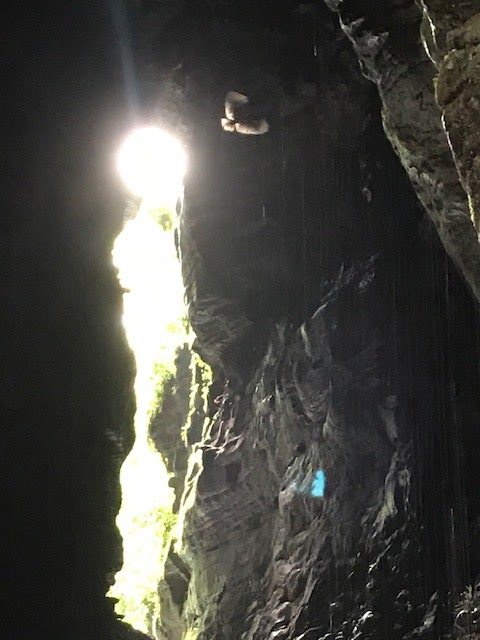
As part of my day-trip, Edison took me to another interesting attraction: La Gruta de Los Tayos.  A gruta is a cave with an opening at both ends, more like a tunnel.  Tayos are known as Oilbirds.  These birds are nocturnal and nest in caves or grutas, but will flutter about when disturbed by somebody walking into their space.  I think this gruta is officially located in the National Park, but the trails to access it are on land owned by a local family.  They charged me a couple of bucks to "guide" me to the gruta and teach me about the ecosystem, and their efforts to preserve their little paradise.  To get there, I was told that I had to hike down a steep trail into a canyon.


What I didn't know was that to get to the gruta, I'd be repeatedly crossing and walking through a thigh-high rushing river.  It wasn't very cold, but it was exhilarating!  


And yes, our presence disturbed quite a few Tayos as they fluttered about. 


All in all, my trip east was a lovely little get-away!


Saturday, February 1, 2020

Inviting in the New Decade, A Ritual for a New Beginning

As the calendar rolled from 19 to 20, I couldn't help but reflect on all that I've experienced in the last decade, and who I am now because of my journey on that very rough road.  

Let's be honest.  For much of the first five years of this past decade, I was a duck.  The kind that look like they're calmly floating on the surface of the water, but who are really paddling like hell underneath.  I was burning out in my job, my marriage was always so hard, and although I was trying to grow and do new things for me (like learning to run and speak Spanish), it was all in an effort to keep it together for myself and my students.  

And then, in 2016 and 2017, I hit bottom.  A mountain of loss threatened to destroy me.  
I had to get out.  
I had to breathe again.  
And so, I ran away to the Peace Corps.  

In January of 2018, I arrived here in Ecuador and my life was suddenly filled with so many new experiences.  Everyday was an adventure and it was a little like riding a wave of fun. 

But grief doesn't just go away.  No matter how much you push it down, it keeps popping up.  You have to come to terms with it.  Face it.  Walk through it.  I spent so much of 2018 and 2019 processing all that had happened, trying to understand the how and why, and struggling to pull myself up out of a deep sadness.  I needed to walk this path to heal, to accept the realities of my new life, and to better understand where I want to go next.  And, mind you, all of this healing and transformation has occurred while traversing a life in Ecuador.  

If you've never lived in a different culture, you can't imagine how hard it is.  First and foremost, after two years, I still don't understand many details of a verbal conversation.  Secondly, I constantly misread cultural cues based on what I know and learned in my own upbringing.  And the stares.  You can never escape the stares.  It's really hard to keep up your self-confidence when you just feel like a fish out of water, and it's exhausting being confused, or completely wrong, the majority of the time.  On top of this, I'm working in a completely different education system with entirely different goals and work ethic than what I've known all my life.  Finally, admittedly by my own choice, I live with a family and spend every day completely immersed in Ecuadorian culture including food, music, clothing, traditions, customs, the way they interact with me and the way they go about their everyday.  It's all so different than anything I've ever experienced before.  Sometimes, I just yearn to return to the States for only one day, just to be able to completely understand the language and culture, and to feel normal again.  Just one day!

Yes, of course this journey has been really fun and rewarding.  I had always wanted to be a Peace Corps Volunteer and this experience has been all that I wished for and so much more.  Those are the stories that fill my Blog Posts.  But it has also been really, really hard.  
Healing.  Growing.  Giving.  Being.  Becoming.

2020.  This is the year I come back.  Emotionally.  Ready for life for Becky.  


And so it began... 

Ecuadorians have many traditions to send off the bad spirits, memories, or events of the previous year while inviting new, positive energies within.  In the final days of 2019, I really took some of these traditions to heart, using them as a catalyst to adopt a new frame of mind and symbolically launch myself into my future.  Writing my heartfelt testimonial and burning it with my Año Viejo (see my previous post) really set the stage for what was to come; on the morning of New Year's Eve, Margarita mentioned to me that she needed to go to the market to buy some things for a ritual bath.  

"A what?  Can you tell me more about that?"

I know that women and men in different cultures around the world have ceremonies during certain stages in their life to cleanse their body and spirit through a ritual bath.  It's not something I've ever experienced before.  But a ritual bath is something that Margarita's mother taught her to do in order to usher in each New Year, and she's taught Jose and her sons how to do this for themselves as well.  This year, she passed the tradition on to me.  This is my story. 

First, I bought two different bunches of herbs.  Some herbs are considered "amargo" or bitter,
while other herbs are considered "dulce" or sweet.  The herb lady at the market had 

several bunches ready to sell to her annual customers, and one inquiring Gringita.  
Then, I went to the flower aisle where they have boxes of rose petals for sale: a big bag for a $1.  Red, of course signifies love and passion.  Yellow is for prosperity, and riches.  
But I also like to think of it as the color for clarity and light.  White represents peace and stillness of your soul.  


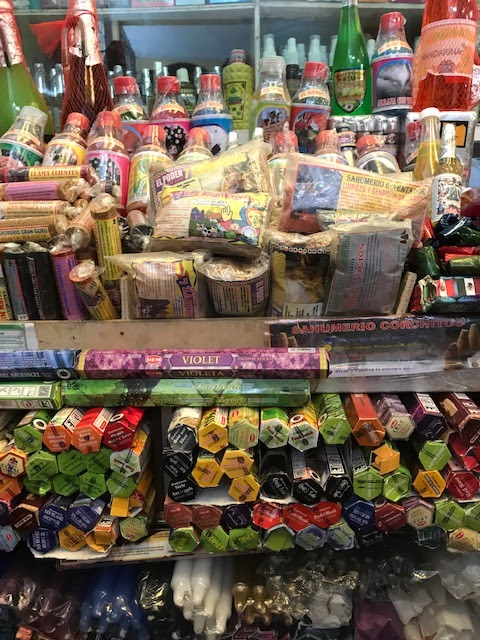
At another booth, I found a variety of bottles filled with perfumes, potions, lotions, 
incense sticks, soaps and candles.  A ritual bath is whatever you want it to be. 


 I used the packaging as a guide and picked out some colored candles for my experience. 

At home, I seeped the bitter herbs in a pot of boiling water.  Bitter herbs include
Chilca, Marco, Gallinaso, Moscera, Ruda, Ortiga (a nettle), Eucalipto (Eucalyptus),
and Santa Maria.  It was explained to me that by pouring this mixture over my body,
it helps wash the impurities and negative energy away.   


I did the same with the sweet herbs, but added some flowers from a Jasmine Bush, Lemon
Verbena leaves (Cedrón) and small, citrus-smelling branchlets from a Mandarine Tree.
The sweet herbs included Manzanilla (Chamomile), Broker, Congona, Tigrisillo, Menta (Mint), Hierba Buena (Spearmint), Cedrón (Lemon Beebrush), Malba Olorosa, Seguiadora,
Abre Camino, Toronjil (Lemon Balm), and Lavanda (Lavender).

To this pot, I also added the rose petals, saving some out for later.

Finally, to the "sweet" pot, I added rich smelling spices such as whole Canela
(Cinnamon Sticks), Clavos de Olor (Cloves), Ishpingo, and Pods of Anís (Anise)
and Pimienta Dulce (Allspice).  It smelled amazing.  I inferred that the pouring of this 
water over my body is supposed to bring more sweetness, or positive energies into my life.

Since I don't have a bathtub, I decided that a bucket bath was going to be the best
approach.  I carried my hot pots to my shower stall and laid out a carpet of petals
for my entrance and exit.  Finally, I lit my candles.


There are no words in English to express how wonderful and cleansing this experience 
was for me.   Perhaps "rich", "luxurious", and "inspiring" come close.  
In Spanish.... "rico".  

Before and during my cleanse, I took the opportunity to reflect on what I wanted to let go of 
in this passing of the year, and what I wanted to welcome into my life and my future.  
And to bathe in sweet-smelling flowers and spices is an experience 
I would highly recommend, for the skin, the body and the spirit. 

Qué Rico!  


Friday, January 24, 2020

Año Viejo.... Traditions to Send off the Old Year

The turning of the calendar to a new year is celebrated around the world, and South America is no exception.  Here in Ecuador, this favorite holiday is called Año Viejo, or "Old Year", and it incorporates many traditions to send off the bad of the previous year while welcoming a new and positive year to come.  Last year, I spent New Years traveling with friends to Riobamba, Ecuador (see post in January 2019), so this year, I wanted to stick close to home to learn more about my family's celebrations.  

First, since our local barrio was hosting their festival on Saturday, December 28th, Jose's extended family decided to hold the Angamarca family party on the same day, just down the road at their parent's farm.  It was decided that we needed three turkeys, a bucket-full of potatoes, salad and lots of beer.  Like any modern family, they coordinate all of this through texts.  It's also their tradition to have organized games to play and a ritual "monigote", or puppet, to burn, in order to cast off the old year.  They drew straws, and my Aunt Carmen became the lucky soul to get a monigote made in her likeness. 


The morning of the party, Carmen's daughter, Susy, and Jose's brother, Sergio, volunteered to make the paper-stuffed monigote.  To send off the negative energy for the old year, it's important to use old clothes that the person has worn.
They spent a long time sculpting it and when they were finished, it looked like Carmen.  Then, Jose and Margarita came along and added some notes or references to some bad or silly things that had happened to Carmen throughout the year.  I watched this process carefully because I wanted to make a monigote of my own.  More on that later.


That evening, after our wonderful dinner, Jose's brother, Kennedy, got the party started
by reading a spoof of Carmen's epitaph, while Carmen and Wilo 
carried her off to the yard for the ritual burning.
Bad spirits of 2019, be gone! 


We also played lots of silly games including musical chairs, and I won the Limbo Contest.

Then everyone at the party started to dance, and it was time to walk
down to the community party.  We could already hear it in full force.

When a 24-person brass band shows up with a giant tent, a light board and a two-story scaffolded sound system, you know it's going to be a good party!  Good thing it hadn't rained in awhile because the dance floor was in a newly harvested corn field. 

Right in the middle of the party, many Angamarca family members had to leave to attend 
an award ceremony.  Los Aguilas, the family Futból Club, had won another championship.  
They returned with a tall trophy and we had more to celebrate!  The band didn't quit until
3am so we danced and laughed, and danced some more. 
Pausing for a picture: Sergio, Jose, Me, Margarita, Carmen, Johana and Susy

My favorite part of these parties by far, is the people watching.  A "jaba", or crate of tall Pilsners, is the common gift to bring to the party.  You carry it around, and with one plastic cup you drink and share.  All night long.  Until you need a nap.  And then, you can just sit on your crate and close your eyes for awhile.  When you wake up, the beer is still there for you to continue the fun.   


On the December 31st, of course, the party continued.  But in addition to music, 
dancing and fireworks, there's a lot of specific traditions which are important to follow 
if you want to send off the bad, and invite in the good, for the new year.


First, it's important to clean the house physically, and cleanse the house spiritually 
with some incense.  Margarita practically smoked us out with some Sandalwood.

If you want to travel successfully in the new year, you need to run around your house 
three times with a piece of luggage like a backpack.  
Here is Pablo demonstrating how to do this.  
Your color choice of underwear will also bring you fortune... 
either in love (red) or prosperity (yellow).
I'm not going to tell you which color I chose to wear! 
Additionally, you must plan ahead to eat 12 grapes exactly at midnight, one for each wish 
that will come true.  Margarita packed a picnic snack of grapes for our midnight adventures. 

Next, you need to make, or buy, your own monigote to burn.

Large, fancy monigotes can cost $50-75 dollars.  


Jose and Margarita opted for one of the plain stuffed dolls for $3.00 and then  
they fitted it with a mask.  At a local New Year's Eve Carnival,
we had plenty to choose from. 


We had fun trying on the masks, too. 
Then, they attached it to the front grill of the truck, 
and we were ready to cruise the town.  


Fireworks are also available everywhere, but we opted to watch everyone else's show, and didn't buy any for ourselves.
Finally, we were ready to experience my favorite part of the Ecuadorian New Year- the Viudas Locas!  These are young men dressed as women, who parade around in the streets stopping traffic and asking for beer money.  Many of them look better in a dress than I do, and their dances get a little risqué as they pretend your car is a pole.  It is hilarious!  And of course you hand your change out your car window to encourage more of this behavior.  
It's all part of the fun!


After our wild ride through town, we finally got to a local party in time
to watch the monigotes burn and ring in the New Year.  


After the celebration, there were games, a raffle and a dance party that promised to take us late into the next morning, but without me.  I decided I had something else to do.  I walked home in the rain and composed a letter to myself.  Earlier in the day, I had scoured up some newspaper, cardboard and a stretched out shirt to make a monigote of my own.  In this monigote, I placed a letter - a list- of all the complicated and compromised feelings I have been holding onto about me, 
my past, my present and my future.  
It was time to let them go...literally, up in smoke.  


At 2 am on January 1st, 2020 I stood in the rain with a glass of wine
and watched the me of my past transform into cinders.   
And with it, I said my goodbyes to a decade filled with pain and sorrow.  
It was time to let it go.